I referred to Zeitgeist - The Movie in an earlier post. No doubt the movie is controversial, removing it from Wikipedia is not a wise move and violated the trust of the mass to the validity of Wikipedia.
I referred to Zeitgeist - The Movie in an earlier post. No doubt the movie is controversial, removing it from Wikipedia is not a wise move and violated the trust of the mass to the validity of Wikipedia.
I wanted to label this post as fun, but I just canNOT. If what is described in the movie is true, this is a REALLY serious situation. From the website:
That being said, it is my hope that people will not take what is said
in the film as the truth, but find out for themselves, for truth is not told, it is realized.
by Tim Stahmer
The original BBC news is here and Tim's summary:
The essential point about the new curriculum is that it gives teachers much more flexibility about how to organise learning.
They do not have to be trammelled by subject labels. They do not have to plod methodically through programmes of study.
Instead, they can pursue learning through cross-curricular themes. They can adapt the pace and content of learning to the needs of individual pupils.
In short, the new curriculum is designed to permit something the government has espoused - without really defining - “personalised learning”.
As one curriculum expert put it, this whole vast exercise of revising the curriculum has really been about one thing - giving teachers permission to use their own professional judgement.
By Mark Pesce
Mark talks about difference of how knowledge is guarded verse how knowledge is shared using Britainnica and Wikipedia as examples.
Unrelated to Learning.
A Chinese blogger has revealed two cartoons by Amnesty International to raise awareness of the US Army treatment to "Enemy Combatants". (Why I keep thinking "Some animals are more equal"?)
by Leigh Blackall
Leigh was offered money to link to an essay writing service. Interested in what they do, Leigh conducted an email interview. The questions and answers are interesting and call for reflection in the role of essay writing as an assessment task.
Here are a few Questions and Answers I found very inspiring:
Does you your service subvert academia? - good bad, doesn’t matter, other…
To some extent, yes, but not without help of educational system itself. Since essays are used as an assessment tool, which is a wrong method for testing student knowledge, students are seeking the way out. This is not bad in itself, since, as previously stated, they receive an opportunity to devote themselves to the path chosen – whether Math, IT, or Dance, but this, perhaps, shapes a wrong worldview, as students have to deal with ethical dilemmas imposed by society, which should not have happened if academic institutions were to develop better assessment techniques and a more personalized, individual interests based educational program.
Do you have alternative visions for knowledge creation and sharing?
With the advent of online social networks, I think that one could definitely come up with an alternative to regular writing assignments. Why not let students communicate and develop their own interest based social networks where they could stand up for their views in academic related subjects that do interest them? For students majoring and/or interested in IT or Math – let them discuss in a written form questions that interest them – both professional knowledge and writing skills would develop. Math and IT students need writing for communicating own ideas in a written form in a professional manner, perhaps, using specialized IT/Math vocabulary. What would develop their writing skills better than an open discussion on an education related topic of own choice? Academic institutions perceive Internet as a threat instead of enjoying all the benefits and opportunities it offers for improvement of education.
Please read the following paragraph and then rate how it has correctly described you from a scale of 0 to 5. 0 means completely not applicable to you and 5 means it is an excellent description.
Note: The following text is generated at the server side for you.
You have a need for other people to like and admire you, and yet you tend to be critical of yourself. While you have some personality weaknesses you are generally able to compensate for them. You have considerable unused capacity that you have not turned to your advantage. Disciplined and self-controlled on the outside, you tend to be worrisome and insecure on the inside. At times you have serious doubts as to whether you have made the right decision or done the right thing. You prefer a certain amount of change and variety and become dissatisfied when hemmed in by restrictions and limitations. You also pride yourself as an independent thinker; and do not accept others' statements without satisfactory proof. But you have found it unwise to be too frank in revealing yourself to others. At times you are extroverted, affable, and sociable, while at other times you are introverted, wary, and reserved. Some of your aspirations tend to be rather unrealistic.
How did I rate?
0
1
2
3
4
5
by Paul Murphy
try timing this:
(1) focus on some text on your screen
(2) move one hand to the mouse, select the text
(3) release the button, focus on a menu, move the mouse to that menu
(4) use the mouse to select something,
(5) refocus on your text, move your mouse hand back, click again.
This week's article in Learning Solution eMagazineis on an old subject which seems never die. From the overview:
Designers face the task of coordinating a considerable effort when they undertake a project that involves object production. This is especially true when the project also requires re-use of existing materials and content. This week's article solves that problem, with a comprehensive ten-step process that you can put to work immediately!
by Glenda Morgan
I like Glenda's title. An alternate title to this post may be "What does your R & D stand for?"
Many would say "R & D" stand for "research and development". The fact is in school, we do a lot of "Repeat and Duplicate" from simple Physics experiments to reciting peoms from the great.
If learning is conversation, we are constantly remixing our understanding with feedback from people we meet and talk to. Which part is yours originally and which is a re-hatch of an idea you have forgotten where you have heard of?
In the article Glenda pointed to, Jonathan Lethem wrote
The idea that culture can be property—intellectual property—is used to justify everything from attempts to force the Girl Scouts to pay royalties for singing songs around campfires to the infringement suit brought by the estate of Margaret Mitchell against the publishers of Alice Randall's The Wind Done Gone. Corporations like Celera Genomics have filed for patents for human genes, while the Recording Industry Association of America has sued music downloaders for copyright infringement, reaching out-of-court settlements for thousands of dollars with defendants as young as twelve. ASCAP bleeds fees from shop owners who play background music in their stores; students and scholars are shamed from placing texts facedown on photocopy machines. At the same time, copyright is revered by most established writers and artists as a birthright and bulwark, the source of nurture for their infinitely fragile practices in a rapacious world. Plagiarism and piracy, after all, are the monsters we working artists are taught to dread, as they roam the woods surrounding our tiny preserves of regard and remuneration.
The distinctive feature of modern American copyright law is its almost limitless bloating—its expansion in both scope and duration. With no registration requirement, every creative act in a tangible medium is now subject to copyright protection: your email to your child or your child's finger painting, both are automatically protected. The first Congress to grant copyright gave authors an initial term of fourteen years, which could be renewed for another fourteen if the author still lived. The current term is the life of the author plus seventy years. It's only a slight exaggeration to say that each time Mickey Mouse is about to fall into the public domain, the mouse's copyright term is extended.
Even as the law becomes more restrictive, technology is exposing those restrictions as bizarre and arbitrary. When old laws fixed on reproduction as the compensable (or actionable) unit, it wasn't because there was anything fundamentally invasive of an author's rights in the making of a copy. Rather it was because copies were once easy to find and count, so they made a useful benchmark for deciding when an owner's rights had been invaded. In the contemporary world, though, the act of “copying” is in no meaningful sense equivalent to an infringement—we make a copy every time we accept an emailed text, or send or forward one—and is impossible anymore to regulate or even describe.
via Accidental Pedagogy
This is an IBM Global Innovation Outlook program's report. The subtitle of the report is
Online games put the future of business leadership on display
The title of the review of this book by ITwire reads:
Want to be a computer scientist? Forget maths
has been largely ineffective as a paradigm for computer science. because mathematicians, notably John Von Neumann and Alan Turing, were intimately involved with the early development of digital electronic computers in the 1940s they transplanted a mathematical model of computation, including the algorithm - commonly understood to be an exact prescription, defining a computational process, leading from various initial data to the desired result - into the fledgling science of computers.
[snip]
The primary questions of computer science are not of computational possibilities but of expressional possibilities. Computer science does not need a theory of computation; it needs a comprehensive theory of process expression.
BusinessWeek mined Apple's CEO presentation skill, something everyone should learn and know.
1. Build Tension
2. Stick to One Theme Per Slide
3. Add Pizzazz to Your Delivery
4. Practice
5. Be Honest and Show Enthusiasm
I would modify the title to "Periodic Table of the Web".
The following is part of the screen capture of the page showing the whole table.
Wikipedia competition, sort of. They are both jokes. One is a joke itself and the other is joke as in fun. You decide which is which.
A conservative encyclopedia you can trust. The truth shall set you free.
Uncyclopedia, the content-free encyclopedia that anyone can edit.
Right near the beginning, the author has given the definition of abject:
abject: utterly hopeless, miserable, humiliating, or wretched: abject poverty.
Please welcome Kin to join me in writing for this blog.
We have known each from the days when we have to hand solder our little computers. Kin started in the dip-switches days and I started soon afterwards with a Sinclaire ZX80. (Anyone still remember this little gem.) We have been good friends mostly because we share very similar interest, albeit Kin is more towards hardware/electronics and I am more towards software and information architecture.
Kin has posted his first post to this blog, "Learning Chinese R/W way". It is a gem!
Please look forward to his later posts, I am sure they will be as interesting as his first.
This lesson was written before, by during the uploading, it was gone somewhere in the wilderness. I have to rewrite it again.
I am very impressed by Albert's way of learning Chinese using computers as we are in the computer era. Chinese characters are ideograms which are depicted the things by using linear lines. Most Chinese characters are built using limited component parts and can be grouped into related words using the same component. Chinese children learn Chinese characters through a tedious process of recognising and writing by imitation. They often make mistakes by putting in the wrong components or some even reverse the components by putting in a mirror image. To learn Chinese efficiently, we should start with the components. Albert has mentioned about the sun, moon and the five elements, and Changjie input method. However, it is hard to remember the keys and their corresponding representations. Thanks to Mr. Peter Kwun Wing WONG of Marymount Secondary School in Hong Kong who invented a system to help his students to master the Changjie input method by associating the keys and the meanings. After learning this leasson, you should be able to remember the keys from A to G which were referred as the natural phenomena by Chu Bongfoo.
Key A represents the Chinese character and also a component 日. To remember this association, Peter used the method which are employed in typing lessons. He put the association as:
A for Apollo which is the god of the sun. So A for Apollo 日.
B for Banana which has the shape of the new moon 月.
C for Coin which is made of gold of metal 金.
D for Door which is made of wood 木.
E for Ebb which is the low tide, so it is related to water 水.
F for Fire which is easy 火.
G for Ground which is the Earth 土.
With the witty way by Peter, you now know the associations of the first seven keys. You can now do some blind-touch typing and learn some new words.
One 日 is the sun. Two 日 together is prosperity 昌. Three 日 together is crystal bright 晶. A 日 and a 月 together means both the sun and the moon, so it is very bright 明.
So by typing one A and a space, you get the sun. By typing two As and a space, you get prosperity. By typing three As and a space, you get crystal. By typing A and then B and a space, you get bright.
One 月 is the moon. Two 月 is friend who spent nights with you 朋. So typing two Bs and a space gives you friend.
There is not much on 金 which has simple combinations with the first seven components.
One 木 is a piece of wood. Two 木 means many trees. So it is a grove or small wood 林. Three 木 means a lot of trees. so it is a big forest 森. If the tree is very tall and large on top of the sun, it blocks the light and therefore cannot see anything 杳. If you put the woods on fire, you burn them 焚. A wood on the ground is the surname of a clan of Chinese people 杜. Here the Chinese uses the sound of one component to mean other things. The sound of ground 土 is used for the sound of the surname.
One 水 is water. Water and gold is 淦 which is the name of a river in China. Water and wood is 沐 which means bathing. Again, the sound of wood is borrowed for bathing. Wood and bath have the same sound. Water and two wood is 淋 which means pouring water over something.
One 火 is fire. Two 火 describes the burning hotness 炎. It is often used to describe hot weather. Fire and earth form the Chinese stove 灶 where the wok is to be put above it and fire inside below the wok.
One 土 is earth or ground. Two 土 is 圭 which is a piece of jade in the form of a sword used by the emperor to signify his standing. When used with 日 as in 日圭 means sun dial.
Now you have learn the associations:
A for Apollo the god of sun
B for Banana the shape of a new moon
C for Coin which is made of gold or metal
D for Door which is made of wood
E for Ebb which is water
F for Fire
G for Ground.
You have also learned that Many Chinese characters are formed by combining the components. Sun, moon, gold, wood, water, fire and earth are some of these components. Some Chinese words borrow the sound of some of these components. by making combinations, you have learned the following words:
日, 昌, 晶, 明, 朋, 金, 木, 林, 森, 杳, 焚, 杜, 水, 淦, 沐, 淋, 火, 炎, 灶, 土 and 圭.
I hope you enjoy this lesson and have learned as intended.
Cheers!
We know that electricity distribution lost a lot of energy. Generation of electricity also produce a lot of heat which we need to warm our homes. But because of job opportunities, we are living in large cities. Here are two thinkings which can keep our environment without lowering our living standards.
Decentralized electricity production using conventional generator
Add printable Solar Cells to ensure that these conventional generator needs not be too large.
To handle (CO2) and other human-generated waste, add a vertical farm which also produces the vegetable for local consumption.
Here is a question of the French's version of "Who wants to be a Millionaire" (translation according to The Speculist by Phil Bowermaster)
Which object obits the Earth?
A. the Moon
B. the Sun
C. Mars
D. Venus
Can you answer this?
The following is the show captured on youTube:
My real question to ponder: Why over half of French think that the Sun orbits the Earth?
Are you one of them? If yes, where did you learn that the Sun revolves the Earth?
Our progress is driven by technology which is driven by science which is driven by evidence-based investigation.
In a previous post, I suggested the following as subjects students must learn today for tomorrow:
Languages (4+1)
Communication skill
Self Entertaining Development
Evidence-based data-based learning
Authentic learning
Do you agree? Should I move "Evidence-based data-based learning" to the very top?
BTW, Moon revolves around the Earth.
The final tally produced this list of the world's top human-built wonders:
• The Great Wall of China
• Petra in Jordan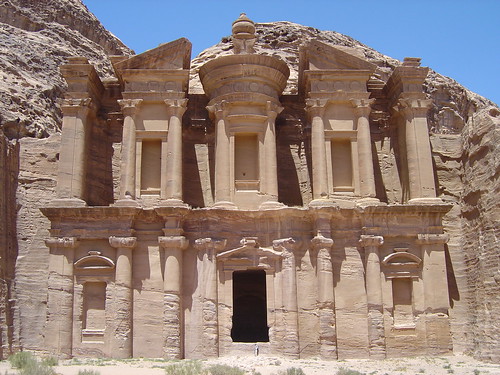
• Brazil's statue of Christ the Redeemer
• Peru's Machu Picchu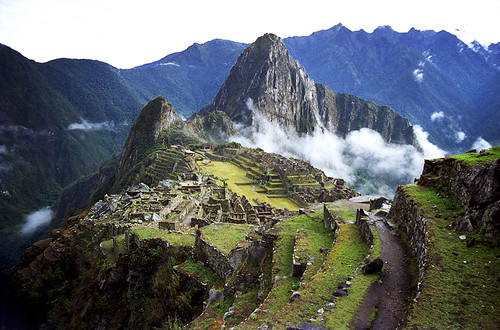
• Mexico's Chichen Itza pyramid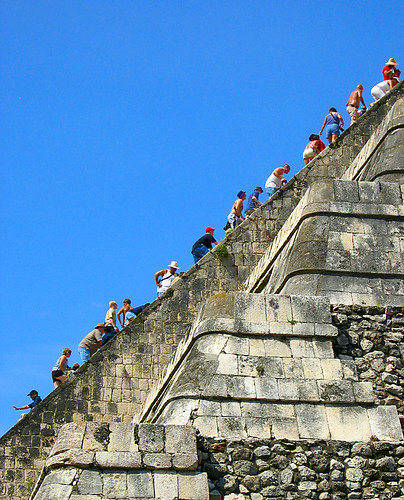
• The Colosseum in Rome
• India's Taj Mahal
photo credits: ascreamingwriter, csimpson, Scott Ingram, Kenny Maths, dejk, Stuck in Customs, locket479
Although I have written this, during face to face conference, I totally agree with this:
Sessions are for presenters. Learning happens in the conversation.
from the website:
Screencast-O-Matic is the free and easy way to create a video recording of your screen (aka screencast) and upload it for free hosting all from your browser with no install!
From Wikipedia
Sicko is a documentary film by director Michael Moore, released in the United States and Canada on June 29th, 2007.[1] It investigates the United States health care system with a focus on the behavior of large health insurance companies, and contrasts the U.S. system with those of countries with universal health care coverage.
by Dave Pollard'
I cannot do any better than Dave himself. So I suggest you read the post.
Here are some gems I have picked up:
everything we want or need to know in the world is waiting to be discovered. That means it is waiting for us to be ready to learn it
Despite (or perhaps because of) our large brains we are inattentive, prone to erroneous prejudgement, distrustful of our intuitions and our subconscious knowledge, and we suffer from dreadful and growing imaginative poverty.
what we should do now is build our capacity to understand -- capacity of attentiveness, openness, imagination, intuition, subconscious awareness, appreciation of complexity, ability to learn and intuit and induce and synthesize and see patterns and adapt and let come and let go. And then show others in our communities why this capacity is so important and help engender it in them, too.
The eye glasses in this video is a MUST-have item in the modern schools. :-)
Sensitivity Training
This is way back, but nevertheless worth a visit.
Two of the 25 "rules" that I will single out are:
5. Education has no economies of scale‚ yet…
22. Learning is more important than Education
via Big Dog,Little Dog
I found the title very strange, uneasy in fact.
To make sure I understand the meaning of "spiritual", I googled:
Definitions of spiritual on the Web:
* religious: concerned with sacred matters or religion or the church; "religious texts"; "a member of a religious order"; "lords temporal and spiritual"; "spiritual leaders"; "spiritual songs"
* concerned with or affecting the spirit or soul; "a spiritual approach to life"; "spiritual fulfillment"; "spiritual values"; "unearthly love"
* lacking material body or form or substance; "spiritual beings"; "the vital transcendental soul belonging to the spiritual realm"-Lewis Mumford
* a kind of religious song originated by Blacks in the southern United States
* apparitional: resembling or characteristic of a phantom; "a ghostly face at the window"; "a phantasmal presence in the room"; "spectral emanations"; "spiritual tappings at a seance"
wordnet.princeton.edu/perl/webwn
The main argument of the author is that informal learning can foster a (a) strong sense of self, (b) concern and outreach to others, and (c) continuous construction of meaning and knowledge.
Durff left a comment in my post Learning is Conversation - Revisited:
Learning is indeed conversation!
via BoingBoing, Aging the Internet Prematurely, One PDP at a Time by Wendy Seltzer
The paragraph picked by Cory Doctorow in BB is
To trust the market, ICANN must be willing to let new TLDs fail. Instead of insisting that every new business have a 100-year plan, we should prepare the businesses and their stakeholders for contingency. Ensuring the "stable and secure operation of the Internet's unique identifier systems" should mean developing predictable responses to failure, not demanding impracticable guarantees of perpetual success. Escrow, clear consumer information, streamlined processes, and flexible responses to the expected unanticipated, can all protect the end-users better than the dubious foresight of ICANN's central regulators. These same regulators, bear in mind, didn't foresee that a five-day add-grace period would swell the ranks of domains with "tasters" gaming the loophole with ad-based parking pages.
Yet that's what it's doing by bureaucratizing the addition of new domain names: Asserting that no further experiments are possible; that the "show me the code" mode that built the Internet can no longer build enhancements to it. ICANN is unnecessarily ossifying the Internet's DNS at version 1.0, setting in stone a cumbersome model of registries and registrars, a pay-per-database-listing, semantic attachments to character strings, and limited competition for the lot.
With the existing model, it would be nice if I could have clifford.eu. Can I have it? No? Is it because the reverend Alan Clifford in Norwich has it? No. Is it because another namesake, Alan Clifford, the BBC broadcaster in Nottingham has it? No. It is because it has been registered by Direct Electronics Inc which appears to be an American company. I wouldn't even mind this except that neither clifford.eu nor www.clifford.eu appears in DNS. So an American company is stopping me, an EU citizen, from obtaining the domain name I want, apparently not using it, and this is with the connivence of the registry authorised by the European commission. The whole thing stinks.
It seems that Google Earth is going to be a very useful tool for teachers and students. I am yet to figure out how to use it, though!
Today's lesson is bit different.
The is wooden block toy, whereas English words can be reformed to Chinese characters of the same meaning.
Here is one of them. Go to their website to see the rest. 
When I wrote What students should learn today for tomorrow?, I am explicit in that "Religious Studies" is ABSOLUTELY not allowed to be "taught" in any school at any time.". I assume so it should be with politics.
From The Huffington Post
DES MOINES, Iowa — GOP presidential hopeful Mitt Romney, courting Iowa conservatives, found himself answering questions Saturday about the role his Mormon faith would play should he win the race.
Romney told one questioner at a forum co-sponsored by a Christian group that "we have exactly the same values" and said there is no religious litmus test for candidates. The former Massachusetts governor dismissed suggestions of a conflict between his religion and his ability to govern. He also hastened to offer assurances of his faith.
"The Bible for me is the word of God," Romney said. "I also believe that Jesus Christ is my savior."
Why pay AUD45+ for a laptop stand when you can:
use wire mess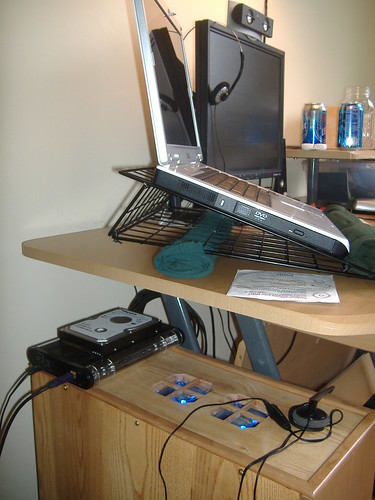
an old towel holder
or two wine cork
me? I use an old oven wire rack!

From the website
The only watch that's also a weapon- it shoots BBs, dried peas, popcorn kernels, lentils and more up to 8 feet accross the room! This stainless steel watch will be the envy of the classroom or the meeting room.
I wrote about the state of broadband in Australia. It was my speculation, no scientific method applied.
On the same track, if Australia were to be a US state, the broadband speed for our average home would be ranked 56 according to this report (via 2Cents Worth). (Assuming the average household will select the middle of the range of the plan and take into account the "shaping" every month when your monthly quota is reached.) See a sample price from one the many similar companies, TPG.com.au. The big name company is not any better, see Bigpond and Optus.


