Thursday, 10 May 2007

Learning Chinese R/W way - Lesson 3

The ability to read Chinese depends on an ability to distinguish between different words. Here are a few words that we have learnt and may confuse you:
十千午年
To confuse you even further, 干 is yet a different word.

To be able to really see the difference, you should understand how Chinese characters are written. Wikipedia has a good article on the eight basic writing principles. Read it now. I will be waiting for you here. Come back after reading it.

千 starts with a "short tapering line thinning toward lower left" (Stroke 7) whereas 干 starts with a "straight horizontal line" (Stroke 2).

Note all the words above do NOT end with "A hook to the left". The last strokes of all of them are just "straight vertical line".

Chinese characters can be written in different "style" or "scripts". Most computer font style is based on either "Clerical" or "Regular" scripts. Now take a look at the example, again from Wikipedia before continuing.

If you have looked carefully, you should have noticed that nearly all strokes start with a slightly larger "head" (in regular script) because when we write them, we pause slightly (or press down the brush slightly) before continuing the stroke. When it is time to turn, we also pause slight (or press down the brush slightly), again creating a slight thicker node. There are two ways to end a stroke: finish the stroke by lifting the brush or by pausing. Please note that some words only differ by how a single stroke was ended.

Please sensitise yourself to these differences. This will be very useful to recognise different Chinese Characters.

In this lesson, we have not learnt any new words. But I hope you have a better understand and ability to find the differences between words that may look similar.

Chinese does not have tense. In the next lesson, we shall learn how Chinese express the time concept we shall talk about pronouns.

PS After I wrote this, I found another useful site which shows how to count pen strokes as well as the order of how to write the character.

Learning Chinese R/W way - Lesson 2

Learning Chinese is easy because it is a very "lego-like" language. Once you know a few characters, you can build on that.

In English, January, February, March, April, ... are all different and hence you need to learn all twelve by heart. In Chinese, 月 means moon - the brightest object we can see at night at the sky. Since Chinese calendar is a "lunar" calender, one month is one cycle of the moon from new moon to full moon and back. By the way, at the beginning of a Chinese month, it is always new moon. Full moon at the middle of the month.

Now back to the month, the same word 月 is used to express western month as well.
January is 一月,
February is 二月,
March is 三月, etc.

Hence by knowing the numbers, you already know how to express the month by knowing one more word, 月.

Two more words to complete your ability to express a full date: 年 (year) and 日(day).

Today, 10th May, 2007 is expressed as 二千零七年五月十日. (Since May is the fifth month in the year) The order is year, month and then day.

What about time? OK, three more characters to learn: 時, 分, 秒. If it is 9:35:42 am, we say 上午九時三十五分四十二秒.

上午 means morning,
中午 means noon, and
下午 means afternoon.

So you may have guess that 午 means middle of the day (noon)! 午時 was the olden way of saying midday.

Look carefully how 上 and 下 are written. The horizontal stroke represent the baseline. So 上 means "above" or "upper". 下 means "below" or "lower". 中 means middle.

Now, I shall also tell you how to express weekdays. No, we don't have to remember another 7 words. We just need to understand that week is western concept. So when it is introduced into China, we need a phrase to mean week: 星期.

Monday is 星期一, Tuesday is 星期二 and so on. Sunday is a bit different. It is not 星期七. It is 星期日.

Exercise:
What does the following mean?
二千零七年五月三十一日星期四 31st May, 2007 Thursday

In this lesson, you have learnt these words:
年月日時分秒上中下午
these phrases: 上午 中午 下午 星期
and how to express date time in Chinese

Next time, we shall look at the characteristics of Chinese character and how to write them. Should be interesting.

Wednesday, 9 May 2007

Learning Chinese R/W way - Lesson 1

I made the point that Chinese is easy to learn (link) and I am going to back it up by teaching YOU Chinese. So let's experiment to see if this claim can be proven.

My native language is Cantonese and I used traditional Chinese since I started school. However, I have been living in Australia for the last 13 years and hence my Chinese is now rusty. I was not very good at natural Language anyway. But I will give it a try. More experienced Chinese Language teachers are welcome to comment, suggest or criticize.

I will try to post at least once a week (more if I have time) and I hope within one year, you will be able to read National Chinese Newspapers such as those listed in here. I also hope that by then, you will be able to communicate in Chinese too. Note: this is a big claim and this is the first time I teach Chinese. (I was a Physics teacher, not language teacher!) If this experiment fails, so be it. In any case, do not sue me if I cannot deliver!

Before we begin, here is another disclaimer. I believe Chinese is a graphical language (contrast to most Western language which is phonetically based). This distinction makes learning to read and write Chinese MUCH easier than learning to speak and listen to Chinese especially when there are so many different dialects within China. So R/W in my title of this post (course) refers to "READ" and "WRITE".

One more thing before we actually start, you need to be able to write (OK, type). For those using Windows, make sure you go to [Control Panel], open [Regional and Language Options], in the [Languages] tab, add Chinese(Taiwan) and input method ChangJie. Do NOT add the Pingyin input method.

OK, Lesson one, let's start with numbers.

一 (one horizontal stroke) is the number one.
二 (two horizontal strokes) is the number two.
三 (three horizontal strokes) is the number three.

If you have installed ChangJie input method, you can try to input these three Chinese characters. Activate your Chinese Input method (the default is [ctrl] [Shift]). To input 一, type the character M on your keyboard and follow by the [space]. 二 is two M's followed by the [space] and ....

Yes, 三 is 3 M's followed by [space].

Well, number four is NOT 4 M's. It is actually quite different.

Here is the Chinese characters from one to ten.
一二三四五六七八九十
I'll discussion the input method for these characters in a later post. Let's learn how numbers are expressed in Chinese first.

Note the character ten (十) is also a place indicator. In English, numbers are advanced every three places. Hence we have ten, hundred and thousand. After thousand, it is ten thousand.

In Chinese, there are four place holders: 十, 百, 千, 萬. This will require a little switching in thinking. So instead of ten thousand, we have 萬.

Now, exercise for you. Translate the following Chinese numbers back to English. (To cheat, highlight the rest of the post.)

一十二 twelve
四十五 forty five
六千七百八十九 six thousand seven hundred eighty nine
三萬七千八百五十六 thirty seven thousand eight hundred fifty six

So far, I have missed out another important number - zero. It is written like this:零. So 2007 is 二千零七. Note, we don't need to use two 零 because a place holder 千 has been used making it perfectly clear that we mean two thousand and seven.

零 is a bit difficult to write, so some Chinese use the Arabic zero instead. However, if you are using Arabic it should be written like this: 二00七.

Now, you can read numbers in Chinese, keep tuned. Next time, we shall talk about how Chinese express date and time.

In this lesson, you have learnt these words:
零一二三四五六七八九十百千萬
and how numbers are written in Chinese

Tuesday, 8 May 2007

Golden Ratio, Plant's growth and Stem cell

by Julie J. Rehmeyer

The seeds of a sunflower, the spines of a cactus, and the bracts of a pine cone all grow in whirling spiral patterns. Remarkable for their complexity and beauty, they also show consistent mathematical patterns that scientists have been striving to understand.


Scientists are trying to understand the relationship of this beautiful display of complexity and
in 1868. German botanist Wilhelm Hofmeister was studying the growing tips of plants, which contain cells that haven't yet acquired a particular function in the plant. These unformed cells are called stem cells in plants and, derivatively, in animals as well. The stem cells form tiny bumps called primordia, which then turn into flowers, stems, or other plant structures.

The primordia form in a small region at the tip of a stem. Hofmeister proposed that the precise spot in which they form within that region is the spot that is furthest from older primordia. The primordia then move outward and downward along the stem as the tip continues to grow.


Is this amazing?

Monday, 7 May 2007

Best Scientific Talk ever

via ScienceBlogs

I totally agree with the title suggested by Scienceblogs which I repeat here. Be sure to watch/listen to question time interaction.


Pure genius, particularly the paper upon which the above talk was based!


I wish my own presentation(s) can be 1% as enthusiastically attended as Doug Zongker's.

Saturday, 14 April 2007

My presentation Powerpoint

Recently, I have been on the road.

On 5th April, Mary Noggle and I presented at The Eighteenth International Conference on College Teaching and Learning:
Creating engaging experiences for students demands time, resources, and technical expertise. Fablusi, an online role-play simulation platform, offers a solution with immersive learning. This paper details the design process of two role-play simulations, discusses both the pros and cons of the two designs, and highlights important issues for designing engaging role-play simulations. Powerpoint

Today, I presented at the eLearning Guild Annual Gathering:
Engaging Learning Experience Using Role Play Simulations
Engaging learning experience which delivers solid and measurable learning outcomes is the Holy Grail of e-Learning. Today there is increasing focus on the use of games in training and learning.
This session will showcase how learners learn while engaged in role play simulations. It will address ways to create engaging learning experiences by using mapping between game goals and learning objectives.

Participants will see how engaging online multi-player role-play simulations are being used in a wide range of subject areas, from political science, to US Army officer training; from South American diplomat training, to workplace training; from American literature training to second-language learning. You’ll learn the common success factors, and the lessons learned, and see how game goals and underlying simulators together can create engaging learning experience.

In this session, you will learn:

* The relationship between learning objectives and game goals

* The differences between stakeholder viewpoints and roles

* How to motivate learners using a compelling kick-start episode

* Framing the context to ensure learning outcomes in line with learning objectives
The powerpoint is here.

Monday, 5 March 2007

Photography Composition Guides

sxc has a wonderful guide on how to crop and/rotate your photo to be more interesting by using simple golden ratio, etc.

The result of the cropping is dramatic!

Is 17 the "most random" number?

Dave Munger in his Cognitive Daily did an interesting experiment. He asked his readers to pick a number between 1 and 20. The "random" number picked by human is biased towards 17.


Is this culture specific? If you are interested to test it and if you are a blogger in languages other than English, please repeat Dave's experiment and tag your post with human-random-generator. If you can, please also leave a comment here so that other may follow to read your result.

Friday, 2 March 2007

Ten commandments of role play simulation

I am your God because I created the virtual world you are now in.
You shall have no other Moderator before Me.
You shall not make for yourself a moderator.
You shall not make wrongful use of the name of your Mod.
Remember the Rest and keep it every hour. (10 minutes away from the computer every hour!)
Honor your other players. (Responds to other's actions as quickly as you can.)
You shall not kill without Moderator approval.
You shall not hack into the software of the virtual world.
You shall not steal other people's role.
You shall bear false witness when needed.
You shall covet your neighbor's wife when needed.
You shall covet your neighbor's house when needed.

Studying and Learning

What is "study"? What is "learning"? These are questions which have as many answers as the number of people you ask.

From the web, here are a few worth noting:

To apply one's mind to a subject in order to acquire knowledge and skill.
www.geocities.com/clearbirds/study/glosstudy.htm

the act or process of using the mind to gain knowledge.
www.teach-nology.com/worksheets/language_arts/vocab/four/quiz/2/

survey: a detailed critical inspection; applying the mind to learning and understanding a subject (especially by reading); "mastering a second language requires a lot of work"; "no schools offer graduate study in interior design"; a state of deep mental absorption; "she is in a deep study"; analyze: consider in detail and subject to an analysis in order to discover essential features or meaning; "analyze a sonnet by Shakespeare"; "analyze the evidence in a criminal trial"; "analyze your real motives"; learn: be a student of a certain subject; "She is reading for the bar exam"; someone who memorizes quickly and easily (as the lines for a part in a play); "he is a quick study"; learn by reading books; "He is studying geology in his room"; "I have an exam next week; I must hit the books now"
wordnet.princeton.edu/perl/webwn

From the paper "What do you do when you study?" Education students define study and describe their study strategies by Alex Radloff, Barbara de la Harpe and Irene Styles

What does “study” mean? Dictionary definitions of the verb, “to study” include, take pains to investigate or acquire knowledge of (subject); read (book) attentively The Concise Oxford Dictionary) and, attend to something with intent to understand it and to improve oneself in relation to it (English and English: A comprehensive dictionary of psychological and psychoanalytic terms). In the context of university, we can efine studying as a process involving a range of appropriate cognitive and etacognitive strategies and requiring effort and personal responsibility aimed at achieving ositive learning outcomes.


On Wednesday night, I attended a session given to my daughter at her school. The presenter summarised "studying" as the process when information is flowing IN, as in reading, listening, watching. To contrast, he said "learning" is the process of information flowing OUT as in summarising notes, doing exercises, solving problems. This is a very simple and effective way of explain this to year-10 students, I guess.

When I discussed this with my business partner Roni Linser, he suggested that learning occurs between information IN and information OUT. The doing of exercises and solving problems are demonstrations of the result of the learning. To him, learning is the "reflections" that occurs between the information IN and information OUT stage. "Reflection" is the catch-all word he used to describe a process we understand little. Connectivism may suggest that learning is the building of links among nodes. My catch-all word would be "integration" of the new information into the existing world view we already have.

I would also argue that "learning" occurs both at the information IN as well as OUT stages. Experimentation typically requires creating new problem (information OUT) and observe for the result (information IN). Good experiments are those that produce results which the current theory cannot explain. Gathering such counter examples pushes the limit of the existing knowledge and provide foundation for new theory.

What is "study"? What is "learning"? The quest goes on.

Thursday, 1 March 2007

What is a rainbow?

I saw this photo on Flickr, which reminds of the physics of rainbow.


I did a quick search on the web and found this article. Should be a good read for those interested in the topic.

Tuesday, 27 February 2007

Screen estate and productivity

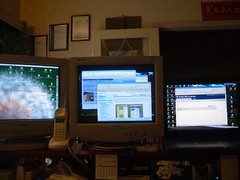
At my home office, I used 3 screens, the laptop connected to a second screen and a Mac (shown on the left). This is a big boost to my productivity as I can process more information at the same time (my internal bio-memory is small and leaking).

via Gismodo, I now learnt that there is a dual screen laptop. May be this is the beginning of multiple screens...

Monday, 26 February 2007

What the future will be?

Worth watching [6 minutes]

Friday, 23 February 2007

What's Special About This Number?

via BoingBoing

BoingBoing listed the first 11 numbers. Here is the next 10.

11 is the largest known multiplicative persistence.
12 is the smallest abundant number.
13 is the number of Archimedian solids.
14 is the smallest number n with the property that there are no numbers relatively prime to n smaller numbers.
15 is the smallest composite number n with the property that there is only one group of order n.
16 is the only number of the form xy = yx with x and y different integers.
17 is the number of wallpaper groups.
18 is the only number that is twice the sum of its digits.
19 is the maximum number of 4th powers needed to sum to any number.
20 is the number of rooted trees with 6 vertices.


Frankly, I don't a lot of the special properties, e.g.

Abundant Number [http://mathworld.wolfram.com/AbundantNumber.html] is a positive integer n for which
s(n)=sigma(n)-n>n,

where sigma(n) is the divisor function and s(n) is the restricted divisor function. The quantity sigma(n)-2n is sometimes called the abundance. The first few abundant numbers are 12, 18, 20, 24, 30, 36, ... (Sloane's A005101). Abundant numbers are sometimes called excessive numbers.

There are only 21 abundant numbers less than 100, and they are all even. The first odd abundant number is
945==3^3.7.5.


That 945 is abundant can be seen by computing
s(945)==975>945.


Any multiple of a perfect number or an abundant number is also abundant. Every number greater than 20161 can be expressed as a sum of two abundant numbers.


Mathematically oriented people surely will be interested in the whole list (from 0 to 9999) which only a few numbers without some significance.

Wednesday, 21 February 2007

Everything You Know About Disks Is Wrong

Here is another paper about failure of disk drives - and this one won the best paper award.

StorageMajo has a good summary. Robin Harris's conclusion is

After these two papers neither disk drive or array businesses will ever be the same. Storage is very conservative, so don’t expect overnight change, but these papers will accelerate the consumerization of large-scale storage. High-end drives still have advantages, but those fictive MTBFs aren’t one of them anymore.

Further, these results validate the Google File System’s central redundancy concept: forget RAID, just replicate the data three times. If I’m an IT architect, the idea that I can spend less money and get higher reliability from simple cluster storage file replication should be very attractive. [my emphasis]

Sunday, 18 February 2007

Failure Trends in a Large Disk Drive Population

google's engineers are presenting a study of disk drive failure at a conference and the 13-page paper is online. If you don't want to read the whole report, TG Daily has a fairly good summary.

The most interesting observation is:

temperature and high usage alone are not responsible for failures by default. Also, the researcher pointed towards a trend they call "infant mortality phase" - a time frame early in a hard drive's life that shows increased probabilities of failure under certain circumstances.

Why I am excited with VAF's break through? Part 1

In this part, I will describe my understanding of the technology behind the current state of play of Web 2.0.

Mesh up of data - mixing of data sources:

  1. Data sources (such as Google Map, Flickr, Criag's List, ...) expose sets of API for user to fetch a customised set of data from the data source.

  2. Data is returned typically in XML or JSON format.

  3. Mesh-up sites take two or more data stream from different data sources, select useful fragments from the returned data and mix with fragments of data from another source to create unique value-added service.


Note that:
  1. the APIs are server-based

  2. these APIs are called by server or web browser client (XMLHttpRequest is available both as a server process as well as implemented by most modern browsers.)

  3. Mesh-up is mixing CONTENT or data depending on how you like to call it.


The second trend is the injection of additional features on a web-page, typically using Greasemonkey extension using user scripts. I will group customised look and feel into the same category. Basically, if an end-user is not satisfied with a web-page, the web-page is changed using either a user CSS (to replace the original look and feel of the web-page) or an injected Javascript through the GreaseMonkey extension.

I still have not seen mixing of AJAX functionalities (ie the first trend above) with user injection.

This is important to note that in both these trends, the original data source or the web page owner is NOT designed to match and mix with any other data source. It is a third party who mixes the data sources or changed the style/functionality of the webpage.

The experiments I did in the VAF break through shows that data sources can also expose their API as a Javascript object/script and enable a pure web-browser based mesh-up. Data provide context, scripts provide functionality. I hope we can see people starting to provide functionality (in the form of javascripts) to allow users to manipulate data from different sources (such as GreaseMonkey script), and VAF will enable different scripts to work together.

恭喜发财 - Happy Chinese New Year of Pig


[Photo by 1980Nic from Flickr]

Tuesday, 13 February 2007

Break through in "Virtual Apparatus Framework"

A decade ago, I embarked on designing a framework for creating interoperable component for creating educational webpages. See Virtual Apparatus Framework.

The key for co-operative interoperability is to enable the components to share data and hence can act on what other component is doing. The technology I have chosen 10 years ago is based on the Netscape's LiveConnect. Different vendors have different level of support of this and hence the VAF has been working and breaking continuously.

Today, I jumped on the idea of sharing via DOM. Here are the experiments:
page from http://www.ipa88.com and page from http://www.scormplayer.com. These pages are exactly the same. Please verify using view page source.

The page loads two scripts, one from www.ipa88.com and another from www.scormplayer.com. All scripts from ipa88.com are numbered oddly while those from scormplayer.com are numbered evenly.

Does this method post a security risk? I don't think so because the loading page has explicitly requested the loading of scripts from two domains - i.e. that's by design!

I have tested on windows XP with only Firefox and IE6. Please let me know your testing result on other platform/browser combination.

Saturday, 10 February 2007

Creating a 3D effect with image editing software

This is a great tutorial by Andrew546. I am glad that it is illustrated using GIMP too.
[photo from one of the comments, by Kandykornhead]

Wednesday, 7 February 2007

Blogumentary

from Google Video

BLOGUMENTARY playfully explores the many ways blogs are influencing our media, our politics, and our relationships. Personal political ... all » writing is the foundation of our democracy, but mass media has reduced us to passive consumers instead of active citizens. Blogs return us to our roots and reengage us in democracy. Shot in candid first-person style by director Chuck Olsen. NOTE: This film is presented here for non-profit, educational use only.


Pretty long, about 1 hour and 5 minutes. [May be worth the time to watch it if you have nothing more interesting to do.]

Tuesday, 6 February 2007

Web 2.0 ... The Machine is Us/ing Us

Click play. The next 4 minutes 31 seconds will be definitely a worthwhile and rewarding time for you - to understand what the web will be / should be.


vi many sources

Friday, 2 February 2007

MaestroLive is a Music Game

I have argued that Commerical Off the Shelf Games Will Not Work in Education. This position may need to change in light of the following program. But I am no music teacher, so I don't know how useful it may be.

MaestroLive is a Music Game. From the website:

MaestroLive is a music game that lets anyone play songs by tapping the rhythm of the song on a computer keyboard or on an attached MIDI keyboard. MaestroLive gives you a score for your performance. When you finish playing a song you can save your score to the MaestroLive network and compare it with previous scores of that song or with other player’s scores. Each song has its own set of scores.


# Choose a song from the MaestroLive Song List.
# Pressing any key on your computer keyboard will play the correct next event (an event is a single note or a group of notes).
# The rhythm radar in the center of the MaestroLive window provides you with a visual indication of when to play the next event.
# By pressing the computer keys in the correct rhythm (using the rhythm radar) you will be playing the song.
# You’re performance score updates while you play – when you finish playing the entire song you can save your final score to the MaestroLive network and compare it with the scores of other players of that particular song.
# MaestroLive can also teach you how to play "for real" if you attach a MIDI keyboard to your computer.


But you must download a program first in order to use it. It is free.

Wednesday, 31 January 2007

Is blogger a jounalist

From WebProNews
In 2004, Apply took the following actions towards Mac fan sites AppleInsider and PowerPage when they reported the technological details about a product codenamed "Asteroid."

Apple sought the identity of the sources who leaked the information by filing suit against the bloggers, and subpoenaed their email records from email service provider Nfox.com. The company claimed that the reports violated California's trade secret laws.


As a result, a Santa Clara County court ordered Apple to pay the legal fees ($700,000) of their opponent this month, a development considered "a large moral victory for bloggers".

WebProNews asks the following questions, which no doubt have been in a lot of bloggers mind for a long time:

Do bloggers qualify as journalists? Can blogs be considered news sites? Does a private company have the right to suspend the protection of journalistic sources guaranteed by the First Amendment?


The situation is still inconclusive. But it seems to be step in the right direction.

Tuesday, 30 January 2007

2006 Generation Next Study

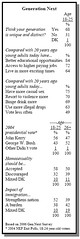
This recent 45-page report from the Pew Research Center for the People and the Press offers a portrait of the so-called “Generation Next”, which applies to those young persons between the ages of 18-25. Based on phone interviews conducted in late 2006 where Pew researchers spoke to approximately 1500 individuals, this report asked participants about their political beliefs, their use of technology as a form of social communication, and their thoughts on immigrants.

I have captured a summary of the statistic on the left.

International Journal for the Scholarship of Teaching and Learning

An electronic publication, twice annually by Center for Excellence in Teaching at Georgia Southern University.

As a way to learn about various perspectives on teaching and learning, it will be greatly appreciated by educational theorists and practitioners. Visitors to the site can learn how to submit manuscripts, learn about the review process, and read details about the editorial review board. Some of their recent articles include “Dialogic Communication in Collaborative Problem Solving Groups” and “What’s It Really All About? The Scholarship of Teaching and Learning as an Authentic Practice.”

Monday, 29 January 2007

Ethics Challenges & Information

David Warlick posted the following questions to his readers and then posted his own response.

"What is your greatest challenge in teaching appropriate, ethical use of web-based media to your students?”


I totally agree with the opening of his response: Content is becoming increasingly networked, digital, overwhelming. Perhaps even more crucial to this discussion is the fact that information has become nearly impossible to contain. There is a critical difference between information and material goods. Information is information is information. Information itself needs a media before it can be manifested. The incremental cost of producing extra copies of the information is decreasing rapidly. Information cannot exist without a media. (Here, media refers NOT to the paper or the plastic of the CD. Media here refers to the community-built system of symbols that the information is used.)

One moral question which we, perhaps most teachers included, has to struggle with - and we can see lots of such discussion especially related to the notion "information wants to be free" - is the concept of Intellectual Property. Is information a property that one can own and hence can demand exclusivity of that property? How and what is the harm to the owner if someone else also enjoys an extra copy of the same information? More fundamentally, should there be an owner of information?

I am writing this post, so common law asserts that I own the copyright of this post. Let say I try to lock away this post so that you are NOT allowed to quote, copy etc... any of this post. So from now on, you are NOT allowed to use any alphabets that I have used in this post without my permission. (Ooops, I did not use the letter z, so you may use it. But now you can't because I have just used it!)

You might say, "No, copyright does not apply to the components of your post. You only have the copyright of your whole piece - the part that is original!"

OK, in fact I used the alphabets which already existed! The alphabets are not my original ideas and hence I cannot restrict others to use them. But is there ANY original idea here? I recycled words. If I have invented all new words in create this post, it will make no sense to you (because you won't know any of the invented words) and hence defeat the purpose of writing this post to communication. So does arranging words constitute originality? In fact, how many new arrangements of words are here? Probably not much, if any!

Strictly speaking, I cannot own any of this post! There is just no "original" parts here.

"I did work in writing this post and if you are enjoying my writing, should I be rewarded?", some may argue.

Right! If I don't want you to read this, I should NOT have published it in the first place. Now thst I have published it, I am demanding reward from you. I am enjoying multiple rewards - the joy of writing and joy of having a readership. My initial motivation to write is already satisfied. Asking for more, to me, seems to be too greedy.

Well, this piece may be too trivial. There are other information that represents a lot of work and they should be protected. OK, if that the case, keep it as a secret. It is unfair for you to plant an idea in my mind and then limit my use of the same idea! Once an idea has gone into my mind, there is no way to unload that information. I may even argue that the information "owner" should pay us to compensate for the damage (if loading a piece of useless information into our mind).

Without an understanding of "property" and how it may be applied to information, the ethical journey has hardly begun.

coop Top Level Domain

This is the first time I see a website with a top level domain of coop. I guess it stands for co-operation. http://energy.biofuels.coop/ The website itself is about energy use and sustainability.

Sunday, 28 January 2007

Roleplaysim.org is up again

I did not realise that the resources on role play simulation were down, probably for a whole month. It is now up and running.

If you have published any paper on the use of role play simulation, please let me know. I would like to link to your paper if possible.

Saturday, 27 January 2007

Never Discussed

via OLDaily

Like Stephen, I agree with Roger Schank's observation that many things are not discussed, or even forbidden to be discussed in school environment.

I understand and totally agree that "School as an instrument of indoctrination" should be made more transparent and acknowleged.

My question is, "Is there anything topic that *really* should NOT be mentioned?" E.g. the debate between evolution theory and creation theory. Should the latter, being totally rubbish, be allowed at all? (OK, this is not the best example! But I hope you get my point!)

Sunday, 21 January 2007

The Eureka Moment

I was reading an article by Guenther Knoblich and Michael Oellinger of the same title of this post in the November/December 2006 issue of Scientific American Mind.

The opening paragraph is
Albert Einstein finally hit on the core idea underlying his famous theory of relativity one night after months of intense mathematical exercises. He had given himself a break from the work and let his imagination wander about the concepts of space and time. Various images that came to mind prompted him to try a thought experiment: If two bolts of lightning struck the front and back of a moving train at the same time, would an observer standing beside the track and an observer standing on the moving train see the strikes as simultaneous? ...

As a Physics students (I even named myself after Einstein), I am ashamed to admit that I have not read that original paper. Now with search so easily done on my desk, I googled and found the English translation of the paper: On the Electrodynamics of Moving Bodies. It was a delightful and satisfying reading.

During the search I also found an essay "'What Song the Syrens Sang': How Did Einstein Discover Special Relativity?" by John Stachel written in 1983.

How did Einstein's Eureka Moment occur?

The Eureka moment might have occurred, as described by Guenther Knoblich and Michael Oellinger in a night suddenly, but Einstein himself had said
"A new idea comes suddenly and in a rather intuitive way. That means it is not reached by conscious logical conclusions. But, thinking it through afterwards, you can always discover the reasons which have led you unconsciously to your guess and you will find a logical way to justify it. Intuition is nothing but the outcome of earlier intellectual experience."

The essay by John Stachel gave a good account of the earlier intellectual experience. The final Eureka moment might be [quoting John Stachel]:
[John Stachel] believe that the first principle, the relativity principle, recapitulates his struggles with the mechanical ether concept which led finally to the first crucial liberation of his thought - the abandonment of the ether. The second principle, the principle of the constancy of the speed of light, recapitulates his struggle, once he had definitely opted for the relativity principle, first to evade the Maxwell-Lorentz theory by an emission theory; then to isolate what was still valid in the Maxwell Lorentz theory after giving up the ether concept and abandoning absolute faith in the wave theory of light. The struggle to reconcile the two principles could only end successfully after the second great liberation of his thought: the relativisation of the concept of time.

As reported by Mark Jung-Beeman, Edward M. Bowden, Jason Haberman, Jennifer L. Frymiare, Stella Arambel-Liu, Richard Greenblatt, Paul J. Reber, John Kounios in
Neural Activity When People Solve Verbal Problems with Insight,
Functional magnetic resonance imaging [snip] revealed increased activity in the right hemisphere anterior superior temporal gyrus for insight relative to noninsight solutions. The same region was active during initial solving efforts. Scalp electroencephalogram recordings [snip] revealed a sudden burst of high-frequency (gamma-band) neural activity in the same area beginning 0.3 s prior to insight solutions. This right anterior temporal area is associated with making connections across distantly related information during comprehension. Although all problem solving relies on a largely shared cortical network, the sudden flash of insight occurs when solvers engage distinct neural and cognitive processes that allow them to see connections that previously eluded them.

Also as noted in the article in Scientific American Mind,
step by step problem solving took place mainly in the left hemisphere, through the conscious application of logical rules, which would rely on deliberate language. The right hemisphere, [snip] played a critical role in solving insight problems, which require restructuring - a spatial task. Individual would experience a eureka moment only when the right hemisphere sent the solution to the left hemisphere, thereby putting the solution into discernible terms.

Tuesday, 16 January 2007

Intrinsic Motivation Learning Design

Way back in May 2005, Scot Aldred posted this piece which is still 100% relevent today. How slowly has education/learning theory advanced?!!

Up until recently, the concept of external motivators has worked well enough for schools and universities who use the lure of certification to ensure that most of their students apply themselves and attain the institutions’ requirements for a qualification.

Scot suggested PBL (problem-based learning) as a potential candidate for providing a more intrinsic motivation. I see role play simulation as an enhanced form of PBL in which we have added game goals in order to give players a more enjoyable learning experience.

Recently, I have been thinking what are the essense of a game when used in a learning situation. I am now starting to converge to two key elements:
1. the underlying context model (simulator if you like, which provides the "content")
2. game goals which provide the motivation for the players within the game context.

The key to designing a good education game is matching game goals with learning objectives. Game goals should be achieved, or better achieved, if the requirement knowledge as specifiied in the learnig objectives have been mastered.

If we can take apart a commercial game and modify either the game goal and/or the simulator, we should be able to create more engaging games.

I think, this is a big IF!

Friday, 12 January 2007

OLPC to include Australia?

From today's Age:

The One Laptop Per Child (OLPC) project aims to put low-cost laptops into the hands of impoverished children in the developing world, but work is already underway to trial them among indigenous populations in Australia.


Proponent acknowledges one major hurdle:
refining the software to a point where it is intuitive and bug-free*, as it is unlikely there will be anyone living among the target populations with the technical expertise to troubleshoot configuration problems when they arise.


While providing affordable hardware to the hands of students may be necessary condition for participation in digital world, it is NEVER the sufficient condition to ensure effective use of the hardware. There are lots of promising uses of digital technology in learning, most educators are still stuggling to understand how digital technology can be fully integrated into k-12 schooling. Hope DEET can understand this and also put in matching initiatives to ensure any available hardware are put to good use.

*Is it possible that a software can be bug-free?

Running is OK, standing is NOT

A strange behaviour of non-newtonian liquid (dilatants - fluids become solid when stressed).


Of course it will be good to be able to do this at a school laboratory. But if you are thinking this is too much, use this smaller version in the laboratory instead.


or this


Science is FUN!

Thursday, 11 January 2007

Microformat & MetaData

Is the world going round and round?

When "IT professionals" discover metadata, everyone is going after it. Well the librarians have years of experience in cataloging information already! The debate, when covering a very diverse set of communities, has difficulty in standardising "metadata elements" and the allowed values in set of the "controlled vocabulary". Everyone has different needs and when politics take front set (and most politicians can code!), metadata is like dead-sea.

Microformat makes use of classes in tags to add "meaning" to the html elements. The class is like "metadata element". We need agreement so that it can inter-operate.

When will they ever learn? When will they ever learn? - I heard my CD playing.

This time around, microformat is driven by coders, people who actually put html elements together. Hopefully, it will not end up like metadata!

Tuesday, 9 January 2007

Physics problem: Poof and Foop

Mark Frauenfelder of Boingboing posted a Physics MC quiz:

This is a stumper. If a can of compressed air is punctured and the escaping air blows to the right, the can will move to the left in a rocket-like fashion. Now consider a vacuum can that is punctured. The air blows to the left as it enters the can. After the vacuum is filled the can will

a) be moving to the left
b) be moving to the right
c) not be moving


As always, the answers (including explanation) submitted are interesting read and review a lot about mis/concept of Physics. All the submitted answers are here.

Sunday, 7 January 2007

Research-Based Learning Blogs

First of all, thank you for including this blog as a "research-based learning blog". Frankly, I only do desk-top research and look at data from Fablusi implementations. But I blog a wide range of subjects of interest to me.

I share with Doug that there are several "walls" dividing educational researchers and education partitioners. Presenting research results in conferences is too expensive and targets only the same group of people. Publishing results in journal can only reach those in univerities, likely to be teachers-to-be rather than real teachers. Blogging, again is blocked by unnecessary firewalls and filters. The practising teaching professionals, unfortunately, working in isolation, do not provide a good environment to advance this field.

Is this indicative of the attention span of web-reader?

[Disclaimer: I was accused of skip-reading years back and I am a serial committer of the same crime. The following is completely speculative!]

Boingboing pointed to a post Female beauty: Ruebens - today which is itself a summary from Dissastifaction with our bodies/eating disorders by Lillith Gallery. The former is a series of photos with minimal description whereas the latter (using the same photos as illustrations) is a lengthly piece. The latter (original as clearly indicated by the former) does not allow comment, so I don't know if the readers would have the same reaction. The interesting thing is the first few reactions from the readers in the former post.

For a short history, yours seems to be quite revisionist. The women shown in the first two paintings aren’t typical ideal women from the 1600’s & 1800’s at all, my guess is you simply chose them to illustrate your rather flimsy “point”.

Since when does boingboing link pages with less merit than a bad grade school essay?


I’m going to have to go ahead and say HIGHLY doubtful.
First of all, you have no proof on whether the Rubens and Renoir represent “ideal” female form of the time, or if they were merely the only women they were able to get to pose nude.
Second, you COMPLETELY skipped the 30’s and 40’s and only giving one example for every other decade.
Last, If you look at examples that actually represent the ideal female form to males (pornography), from the 50’s on to present day the “ideal” female form has pretty much stayed the same.. curves and breasts. If you’re talking the ideal female form to females (fashion magazines) then you’ll find the slender, slim, stupid skinny sharp feature girls pretty much from the 70’s on to present day. Since when was Karen Carpenter’s anorexia EVER considered an ideal female form by anyone? I know more guys that would have chewed off their own leg to sleep with a Russ Meyer girl or Farah Fawcett. I’ve never heard of anyone that thought Karen Carpenter was hot, female or male.

I am going to have to say this is probably one of the most disappointing articles/websites boingboing has ever linked to


Here are my speculative summary:
Web-reader reacts, like me, to the immediately presented information without too much thought given to what s/he wants to say.

Web-reader forgets about the original purpose of the website once s/he gets used to the website (here, I am refering to Boingboing) and switchs back to the way s/he always percieve information. What I am trying to say here is that the two readers who left the two quoted comments above come from an academic background and forget that "BoingBoing is NOT the pinnacle of information, but just a pool of interesting web savvy."

Discussion is where the learning really occurs. A few comment down, here is an example:
Just because the author used only two examples of the weight of women in the 1600 and 1800 doesn’t mean that was the artists preference. Being thin during that time was a sign of poverty. It meant you didn’t have enough to eat or the nutrients to gain and maintain weight. Just as in that time as well women were ideally never tanned. If a woman was tan it meant she was also poor. She worked in the fields. She didn’t have servants to care for her SHE was the caregiver.

In addition I believe the author’s use of Karen Carpenter and her Anorexia is simply to show how women and society has grown towards women should be these thin, whisper of a being. Anorexia is one of the biggest problems facing young girls today. There are advocates and websites devoted to advocacy of it.


Discussion is triggered by stupid responses at the beginning. I doubt if there were no such response at the beginning, there would have such lively discussion later on.

The power of A-list website is also clearly demonstrated there as well. The original post was posted on 12.27.2006 (What!! there is no month 27th! Sorry it must be the American.) 27th December, 2006. The flood of comments started on January 5, 2007. The two comments I reported here at the beginning belonged to those coming from Boingboing.